Technical Overview
What makes Interpreter24 operationally strong for buyers, adopters, and on-site technicians.
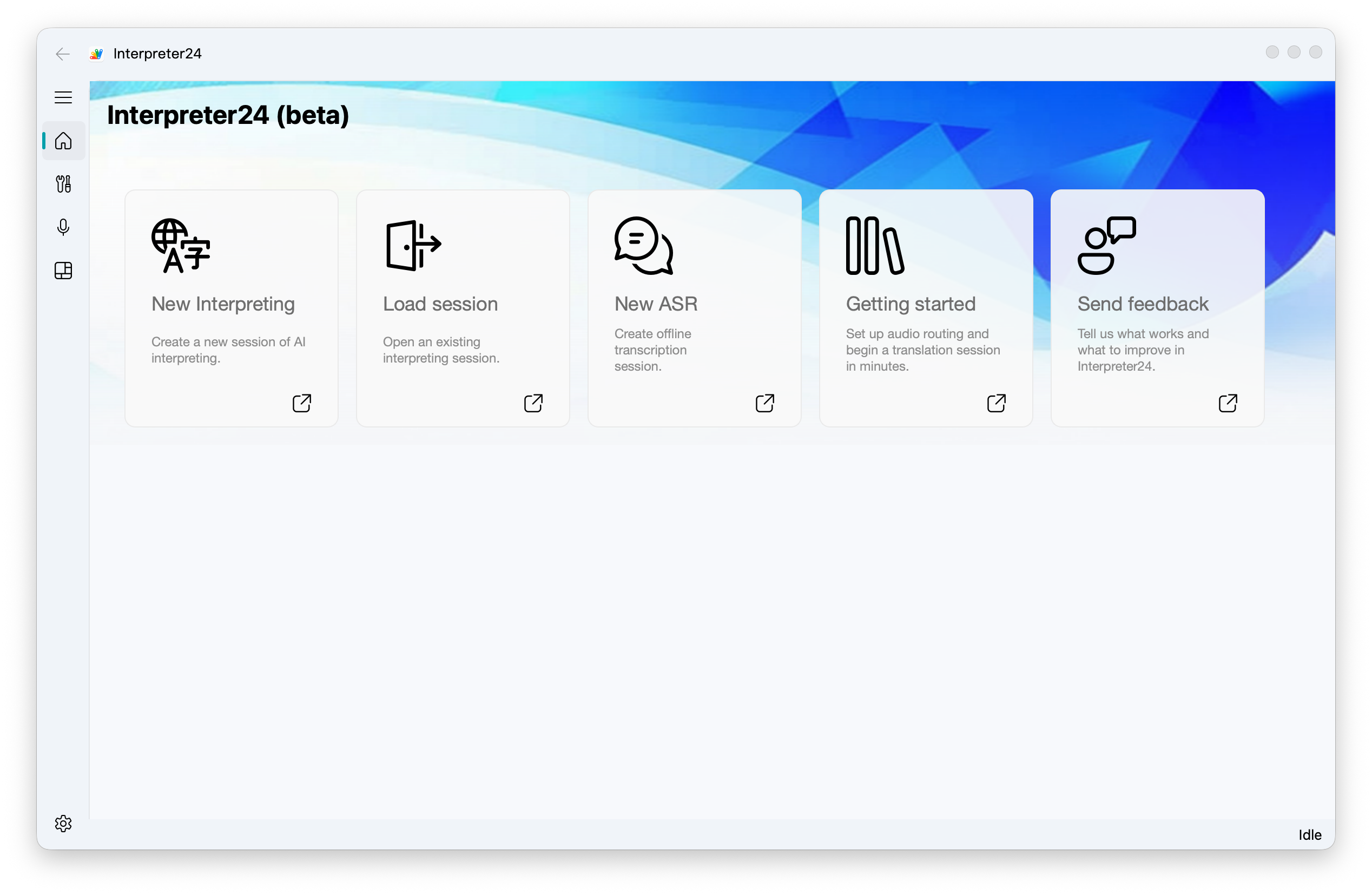
Built around event operations, not just translation APIs
Interpreter24 is engineered as a desktop-first control layer for live environments. The architecture combines speech-to-text, translation, captioning, and voice output with explicit session control, routing options, and telemetry. This makes it suitable for conference operations where predictability matters as much as language quality.
Unlike a single-purpose caption widget, the product supports both local audio infrastructure and cloud-based listener access, while keeping one operator workflow across modes.
Technical Capabilities Buyers and Technicians Care About
Dual Delivery Architecture
Run sessions in USB mode for local multichannel audio output, or cloud mode for mobile listening and remote participants. Same session definition, different delivery path.
Per-Language Channel Strategy
Each target language is treated as its own output channel, with backend orchestration designed for parallel language feeds instead of a single mixed output.
Live Captions + Pop-Out Monitor
Operators can monitor transcripts and translations in-app and pop captions into a detached window for dedicated confidence monitoring during events.
Latency-Aware Voice Output
The TTS pipeline applies adaptive speed control based on lag, helping spoken output catch up when real-time conditions become challenging.
Operational Features From the Codebase
Session Wizard With Deployment Logic
The session creation flow collects source and target languages, session type (captions-only vs captions+voice), and route selection. Captions-only sessions can bypass unnecessary broadcast complexity while keeping metadata consistent.
Custom Vocabulary + Multilingual Glossary Layer
Operators can add pronunciation hints (sounds-like) and multilingual glossary mappings per session. This is critical for brand names, speaker names, and domain terminology in recurring programs.
Robust Storage Modes
Session persistence works with local SQLite or server-backed storage. Stored metadata includes language sets, routing mode, room id, devices, status, and customization payloads, enabling repeatable operations.
Usage Metering and Reporting
Usage events are aggregated into daily metrics (audio time, caption tokens, errors) and exposed in both UI reports and server views. This supports internal costing, client reporting, and SLA tracking.
Secure Runtime Configuration
The app supports short-lived token retrieval, license validation, and TLS trust-store handling for packaged deployments. This reduces key exposure and improves deployment hygiene across client environments.
What Is Unique for Adopters
The uniqueness is not one model call. It is the integration layer: language pipeline orchestration, output routing choices, session lifecycle management, vocabulary control, and measurable operations in a single operator-focused product. This allows teams to start quickly, then scale into repeatable multilingual delivery with real governance and data.